








TOGETHER, WE CAN MAKE A DIFFERENCE
 In 2008, a group of Nantucket citizens concerned about the harmful consequences of the beach-dredging project then being proposed by the Siasconset Beach Preservation Fund (SBPF) joined together. They formed the Coalition for Responsible Coastal Management. The immediate purpose of the Coalition was to generate a strong NO vote on Ballot Question #5 at the upcoming Nantucket Town Election and to call for the development of a comprehensive Coastal Management Plan for Nantucket. That effort was overwhelmingly successful.
Since that time, we have learned more about (1) erosion, (2) erosion control and (3) the consequences for Nantucket’s coastal environment. As erosion-control projects begin to proliferate around the island, concerned citizens once again feel compelled to act. This call to action has also been fueled by SBPF’s persistence in trying to hard armor the bluff in ’Sconset despite the Conservation Commission’s denial of their recent proposal.
The original Coalition—whose members are a diverse group of fishermen, environmentalists, naturalists, seasonal and year-round residents—is regrouping with a broader mission: To preserve and protect Nantucket’s coastal resources, especially our natural beaches. The Coalition has a new name—the Nantucket Coastal Conservancy and a new graphic look.
Our immediate objectives? (1) To inform the community about erosion, erosion control and the consequences for our beaches. (2) To participate in the process of developing a comprehensive Coastal Management Plan for Nantucket, the first in the Commonwealth. (3) To closely monitor erosion-control proposals and work to ensure that they have no adverse impacts on our beaches.
Your support for the Nantucket Coastal Conservancy and our mission will make all the difference in our ability to preserve and protect our island's natural beaches.
Are you with us?
If yes, please click the COUNT ME IN button.
D. Anne Atherton
Mike Gillies
Coordinators

Q & A: What we all need to know about coastal erosion, erosion control and the most recent proposal by the Siasconset Beach Preservation Fund (SBPF).
Question: What exactly is coastal erosion?
Answer: Coastal erosion is a natural process that occurs through the actions of wind, waves, currents and drainage and results in the loss of sediment in some places and accretion in others. The process by which sediment, mainly sand, is moved along the shore—and around Nantucket—by wind and currents is called littoral transport, or littoral drift.
Question: How does erosion affect Nantucket?
Answer: In layman’s terms erosion shapes our ever-changing coastal environment and, in fact, creates our island’s beaches. Headlands and coastal bluffs erode to form beaches, dunes and offshore sand bars as sand is transported and deposited by waves and wind. When erosion is stopped, down-drift beaches stop growing.
Question: Has erosion always been a fact of life on Nantucket?
Answer: Yes, erosion has existed for millennia and has made, and continues, to make Nantucket Nantucket. Our shoreline has always been shifting, as are all shorelines. The fact is that shorelines are not “lines” at all but transition areas located between the land and the sea.
Question: How have Nantucketers dealt with erosion over the decades?
Answer: Over the years islanders—on Tuckernuck and Muskeget, as well—have opted to relocate structures, and infrastructure, out of harm’s way, or, accepting the inevitable, simply left them to be destroyed by the ocean. [In his book, “Nantucket: A Natural History,” Peter B. Brace provides detail about erosion on Nantucket and various attempts to deal with it in the chapter titled, “Erosion, the Reaper.”]
Question: How have residents of Baxter Road in ’Sconset reacted to erosion of the bluff there?
Answer: Erosion has been threatening the bluff in ’Sconset for decades. When the original 88 lots upon which these structures are located were laid out by the developer, William Flagg in the early the late 19th century, the parcels purposely included plenty of land for inland retreat. Unfortunately, over the years, various property owners subdivided these parcels and sold them off, leaving themselves and subsequent owners little room to move their structures back from the edge of the eroding bluff. [“Nantucket, A Natural History,” by Peter B. Brace, 2012, pp. 254-266.]
Despite this, in the recent years, 16 property owners have chosen to relocate their homes either off of their lots entirely or landward from the bluff. [Information provided by SBPF dated August 1, 2012.]
Question: What about Sankaty Lighthouse?
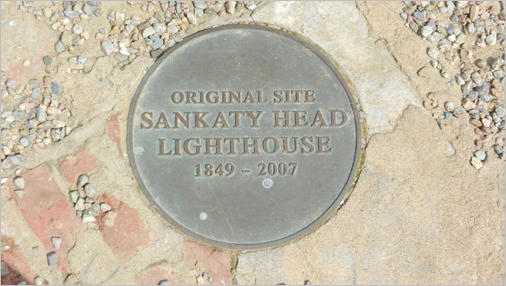
Answer: The Sconset Trust decided to move the historic lighthouse back from the eroding bluff, where it had stood for over 150 years, and did so in 2007, at a cost of about four million dollars, raised through private subscription. The iconic beacon is now located some 450 feet back from the bluff out of harm’s way, at least for the next 100 years. [Go to http://www.sconsettrust.org/Sankaty.html for more information and photos of the move.]
Question: What is SBPF?
Answer: SBPF is the commonly used abbreviation for the Siasconset Beach Preservation Fund, a 501(c) 3, private non-profit organization established by a group of ’Sconset residents “concerned about erosion of the Sankaty Bluff and the threat it poses to the village of ’Sconset.” Since its founding in the mid-1990s, SBPF has proposed and installed several erosion-control engineering devices designed to slow erosion and protect homes perched on the top of the bluff. [For more information about SBPF, go to http://www.sconsetbeach.org/about_us.html]
Question: How does SBPF protect beaches, as its names suggests?
Answer: Actually it doesn’t. Despite its name, SBPF is about preserving private homes, not beaches. The scientific reality is that erosion creates beaches, and efforts to halt or slow erosion, result in degradation and eventual destruction of beaches.
Question: What local regulatory body is involved in the permitting of erosion-control structures?
Answer: The Nantucket Conservation Commission, a body of 7 citizens appointed by the Board of Selectmen, hears applications for proposed work within the jurisdiction of the local Wetland Bylaw and the State Wetlands Protection Act.
Question: If the Conservation Commission is the body that regulates erosion-control projects, such as those proposed by SBPF, why is the Town of Nantucket involved?
Answer: The Town is involved in SBPF matters because the beach below the bluff, or most of it, unlike most other beachfront property, is owned by the citizens of the Town of Nantucket. This is the property on which various SBPF erosion-control projects are, and have been, sited. Consequently projects cannot be built unless the property owner, the Town of Nantucket, gives permission. [See map below. Town-owned parcel 48 8 outlined in red.]
The coastal property below the bluff in Siasconset is a vestige of the Proprietors’ Roads that were originally laid out along the perimeter of the island and the great ponds by the early Nantucketers. In actuality, the Siasconset property owners whose houses sit atop the bluff are not waterfront property owners. The Town is.
[For information about the Proprietors’ Roads, go to the Town website at http://www.nantucket-ma.gov/Pages/NantucketMA_BComm/rowcom and click on HISTORY OF ROADS AND WAYS. The history was researched and written by Frances Ruley Kartunnen, noted island historian, for the Town and County of Nantucket Roads and Right of Way Committee in 2008.]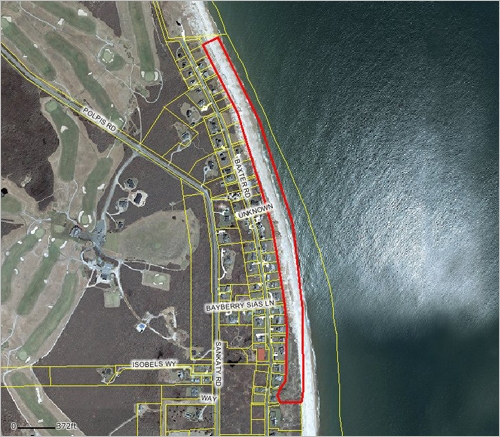
Question: So the various SBPF erosion-control projects that have been installed during the past twenty years or so have been located on Town-owned land?
Answer: Yes. The citizens of Nantucket have, in effect, allowed SBPF to use public property to attempt to protect their private interests. [See Map and Parcel numbers 49 9 and 48 8 for properties owned by the Town of Nantucket below the bluff. Parcels can be viewed on the Town’s GIS system. Access it be going to http://www.mapgeo.com/NantucketMA/.]
Question: What are some of the ways in which SBPF has tried to control erosion?
Answer: A number of different projects have been installed. Beach de-watering systems were permitted and installed in three locations along the Siasconset shoreline. Beach terracing was initially installed with sand-filled coir (coconut fiber) bags, treated timbers and plastic dune-guard fencing. The terracing design was amended several times to remove several of the more problematic elements including the timbers and dune-guard fencing. The most recent terracing permit included using sand-filled, jute “burrito” bags held in place with anchors and covered with sand.
Question: Were they effective?
Answer: The beach de-watering systems did not function as they were intended to, and nearly ten years after initial installation, the northern two were finally removed from the beach. One system still remains in place beneath the beach at Codfish Park.
Aspects of the terracing projects have been successful which is evident from the peninsula like bulge of the properties that have been constantly re-nourished (covered with sand) and maintained. However, most of the harder elements including the timbers and dune-guard fencing were not effective and caused a great deal more harm than good. Some terracing collapsed during a storm: Treated timbers and coir netting bags were strewn along Nantucket beaches and waters for months. Fortunately, no one was injured by this debris.
Question: Didn’t the voters say NO to a SBPF proposed project a couple of years ago?
Answer: Yes, the voters overwhelmingly said no to SBPF’s use of Town-owned land below the bluff for a beach-dredging project. After the ballot vote, SBPF withdrew their application which was pending before the Conservation Commission.
Question: Why are we talking about this again?
Answer: Since the decisive ballot vote in 2008, SBPF has developed a new erosion-control proposal. This one is an engineering project that would in effect “hard armor” the toe of the bluff with rocks to be covered periodically with sand excavated from mid-island and trucked to Siasconset.
The initial proposal sought permission from the Conservation Commission to construct the rock apparatus in front of three homes in the northern section of the eroding bluff area and three homes in a more southerly section. SBPF indicated its intention to the Conservation Commission that, if this engineering project were successful, they would like to expand the project and install it in front of 20 homes in total.
Question: What is “hard armoring”?
Answer: According to our local Bylaw, hard armoring is defined as “any bulkhead, revetment, seawall, rep-rap, groin, jetty, artificial seaweed, plastic sheeting, or other structure intended, or constructed so as, to prevent or alleviate storm damage, or modify tidal action, wave action, littoral flow, or erosion.”
Question: Is hard armoring allowed?
Answer: Currently, new coastal engineering structures are only allowed under the local Bylaw to protect structures that were constructed, and not substantially improved, prior to the implementation of the regulations, 1978, unless a waiver from these regulations can be justified.
Question: Did the Conservation Commission permit the hard-armoring project?
Answer: No. After almost six months of hearings and a voluminous amount of oral and written testimony, the Commission closed the public hearing, deliberated and voted NOT to permit the project. The vote to deny was 5 to 2.
Question: What was SBPF’s response?
Answer: SBPF responded by appealing the decision of the Commission, both on the local and state levels, and asking the Court to order the Town to pay SBPF’s legal fees for pursuing the appeal.
Question: What is the status of the appeal?
Answer: Following negotiations with Town Counsel, SBPF withdrew the appeal. Rather than continue to sue the Town, SBPF has chosen to “resubmit” the proposal to the Conservation Commission.
Question: Can they do that?
Answer: An applicant is prohibited from resubmitting a proposal after it has been denied for a period of three years, unless there are “material” differences in the resubmission.
Question: What are the differences in the “new” proposal from the one originally submitted?
Answer: The “new” submission proposes to stabilize the bluff with an engineered system of rocks to be covered with sand, just as the previous one. The differences, which appear to be minimal, are two fold: one, the scope of the project has been reduced by about 50% and now pertains to only one cluster of three homes, rather than two clusters of three homes each; and, two, the anchoring system by which the rock-filled baskets and mattresses are to be fastened to the toe of the bluff has been modified.
Question: Do these modifications constitute “material” changes?
Answer: On August 8, the Commission determined by a vote of 4 to 3 that the differences in the new proposal do constitute “material” changes and the Notice of Intent can go forward. The public hearing on the “new” Notice of Intent will now continue.
Question: We keep hearing about an SBPF “pilot” project. Is this it?
Answer: Apparently. SBPF is referring to this scaled-down version of the hard-armoring project that was denied by the Commission as a “pilot” undertaking designed to “provide scientific data” for the Town’s Coastal Management Plan (CMP) Work Group.
[It is interesting to note that SBPF referred to their first hard-armoring project as a “pilot” project also, and is still described as such on their website under CURRENT PROPOSAL. http://www.sconsetbeach.org/current_proposal.html]
Question: Has the CMP Work Group asked for such data?
Answer: No. The CMP Work Group is reviewing data on other similar projects that have been in place for some time to analyze their impacts and effectiveness. The charge of the BOS to the CMP Work Group expires in December 2013. Therefore it will not be possible for the CMP Work Group to use any information derived from this project even it were installed tomorrow. It takes many years to observe and assess such projects. This point has been made publicly by Dr. Ernest Steinauer, Chair of the Conservation Commission.
[For information about the CMP Work Group go to the Town website at http://www.nantucket-ma.gov/Pages/NantucketMA_BComm/coastalmanagement]
Question: SBPF is saying that Annual Town Meeting approved the proposed pilot project. Is this true?
Answer: No.
In a recent communication SBPF stated the following: “When we last wrote to you in late April, Town Meeting had recently voted its approval for our 400-foot revised project after a spirited and thorough debate at both its Saturday and Monday sessions.”
However, this statement is patently false. The matter before ATM related to the moratorium currently in place that prohibits coastal-erosion projects on Town-owned land on the eastern side of the island until a Coastal Management Plan is adopted. The pilot project itself was never before the voters.
Town Meeting voted to allow the moratorium to be lifted for SBPF’s pilot project if it receives all necessary permits and approvals. Town Meeting also acted to ensure that all future such projects on Town-owned land be subject to approval of Town Meeting, but it exempted this SBPF pilot project from such a vote.
The full discussion of the two articles, Articles #61 and #65, is available online for viewing at http://vimeopro.com/nctv18/government
Question: Why does SBPF state that the voters “approved” the project at Town Meeting?
Answer: SBPF has a history of overstating their case.
This happened with the previous beach-dredging project. At that time, SBPF said that the proposed project would protect the village of ’Sconset, the Town sewer beds, and even Nantucket Airport. The fact is that erosion was not threatening any of these areas. The village has been there since the 17th century, the land seaward of the sewer beds is actually accreting, and the airport is miles always from the proposed project. In addition, Sankaty Lighthouse, featured prominently in the SBPF logo at that time, had already been moved to safe ground, out of harm’s way.
Four years later, it is happening again. As recently as August 8, attorneys for SBPF represented to the Conservation Commission that the voters had, to paraphrase, “approved the pilot project at Town Meeting.” No evidence was submitted to substantiate the claim because none exists. (As discussed above.)
Although SBPF spends thousands of dollars on public relations, Nantucket citizens are savvy about recognizing spin when they see it.
Question: If erosion creates beaches and hard-armoring installations degrade or destroy them, is Nantucket’s natural shoreline threatened, especially as more and more waterfront property owners attempt to stabilize the beaches in front of their homes?
Answer: Yes. There are already several erosion-control devices that have been installed along the north shore that are severely affecting the natural coastline. These erosion-control, engineering structures and their effects can easily be viewed on Google Maps. The cumulative impacts of such projects will—and are—altering Nantucket’s natural shore, especially if they are permitted to proliferate.
Question: What do you mean by “threatened”?
Answer: Beaches on which erosion-control structures are installed are, by definition, compromised. More specifically both “soft” and “hard” methods of erosion control generally result in a loss of sand (both on the beach on which the structure is installed, as well as the coastal areas adjacent to it), narrowing of beaches, loss of habitat and, especially critical for Nantucket, restriction of, or in some cases loss of, public access.
Question: So, when it comes to hard armoring, is the choice to be made between saving structures or saving beaches?
Answer: Yes. As Cornelia Dean, former Science Editor of the NY Times, explains in her 1999 book, “Against The Tide: The Battle For America’s Beaches,”
Erosion does not threaten the beach per se. Left to confront a rising sea alone, a beach will simply move inland. Decisions to armor the coast are not decisions to save the beach—quite to the contrary. They are decisions to sacrifice the beach, or a neighboring beach, for the sake of buildings. [Page 66.]
Question: Is there no other alternative for the property owner?
Answer: Yes, there is an alternative that is a win-win for everyone: Relocation.
Moving a structure landward out of harm’s way, as was done with Sankaty Lighthouse, causes no harm to the coastal environment, and “saves” the structure. It also “saves” the beach. The Directors of the ’Sconset Trust are to be recognized—and thanked—for choosing an alternative that is the best interests of all parties, including Nantucket’s.